Assessing Coverage Performance for Space Missions
Coverage assessment: from orbits to mission-level performance
Designing an orbit is only the first step. Once satellites are placed in space, the real question becomes simple and decisive: what does the mission actually cover, and how well?
Coverage assessment transforms orbital geometry into mission-level insight. It allows engineers to quantify visibility, revisit, persistence and performance over specific regions of interest, turning trajectories into measurable mission value.
At its core, coverage analysis answers a fundamental question:
When, where and how often does a satellite — or a group of satellites — observe a given area?
Rather than working with abstract orbital elements, coverage assessment focuses on operationally relevant outputs: which areas are covered, how frequently coverage occurs, how long each access lasts and how coverage evolves over time.
Defining areas of interest and sensor geometry
Every coverage analysis starts by defining what actually needs to be observed.
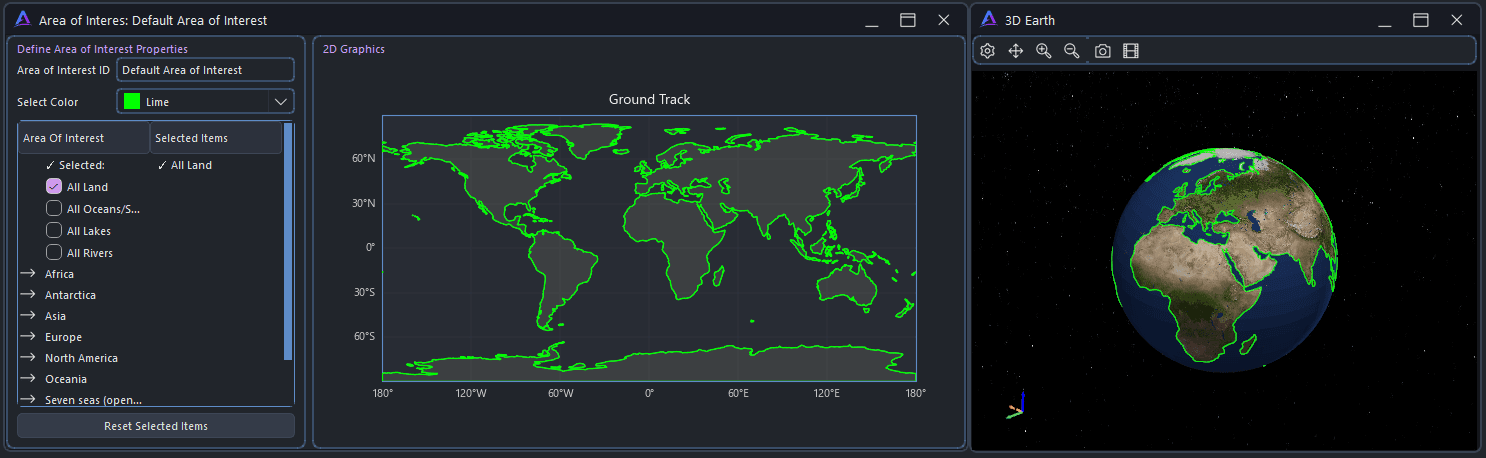
Areas of interest can be defined at different scales, including entire countries, continental regions, custom geographic polygons or individual points of interest such as cities, ground stations or critical assets.
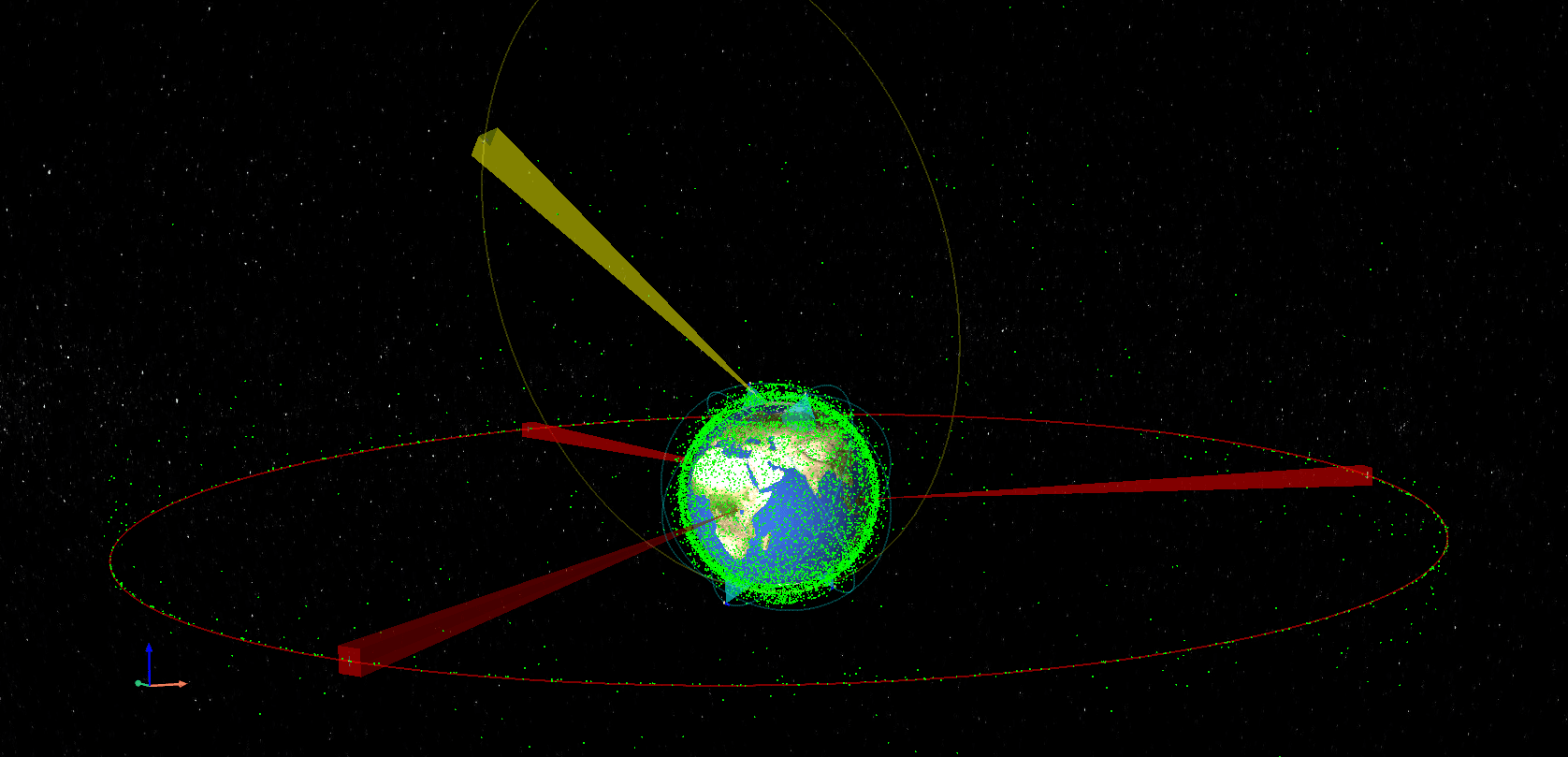
At the same time, sensor geometry plays a central role in determining coverage performance. Both conical and rectangular sensor models allow engineers to represent realistic instrument footprints, linking spacecraft attitude and pointing constraints directly to surface visibility.
This combination of geographic definition and sensor modelling provides the foundation for meaningful coverage assessment.
From single-satellite to multi-asset coverage
For early mission concepts, coverage analysis often begins with a single satellite. This allows designers to evaluate whether the selected orbit is appropriate for the target region, estimate revisit times and identify potential gaps in observation.
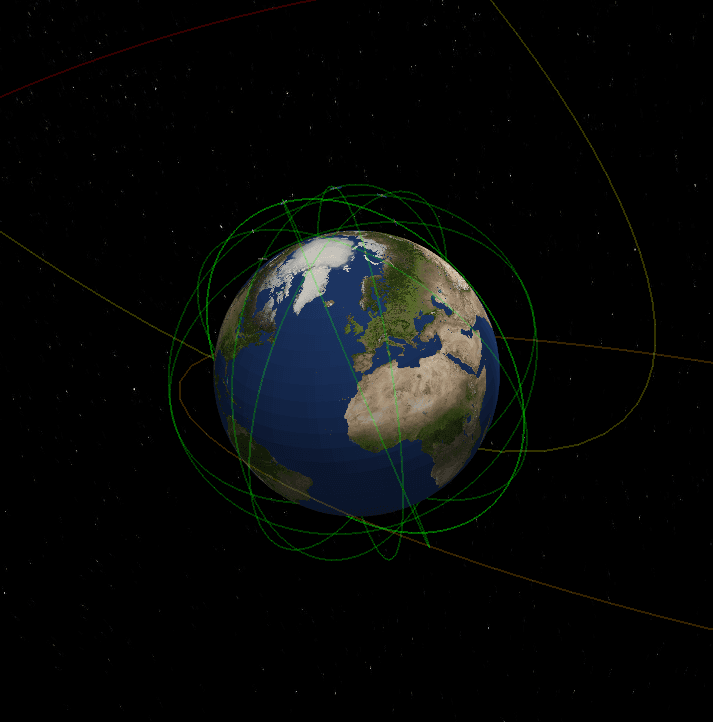
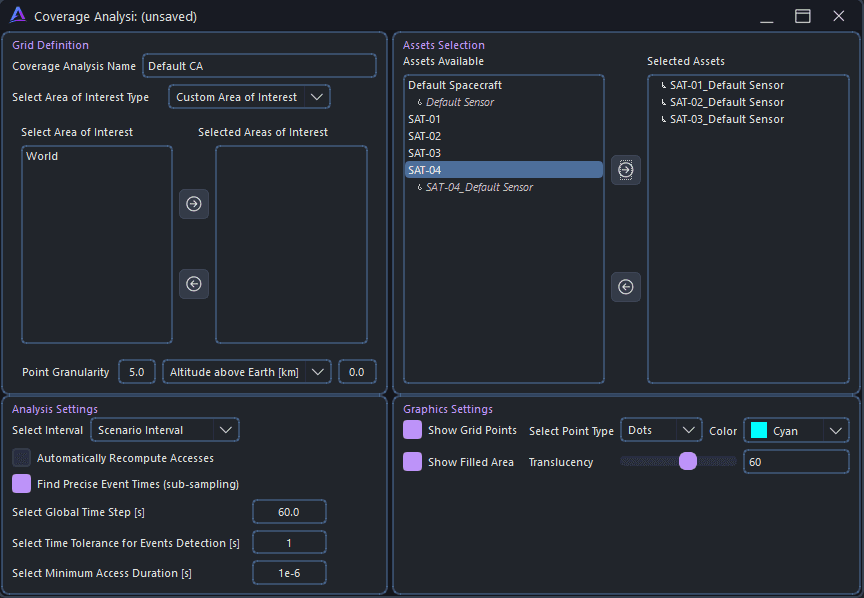
Modern missions, however, rarely rely on a single asset. Multi-asset analysis enables the evaluation of constellations, phased deployments and mixed orbital architectures, combining the coverage from all assets into a unified system-level view.
By aggregating contributions from multiple satellites, engineers can assess how constellation size, phasing and orbital diversity influence overall mission performance.
Understanding coverage metrics and visualising performance
Coverage is not binary — it is characterised by metrics that describe how well a mission performs over time.
Key indicators include revisit time, access duration, temporal gaps and persistence. These metrics allow different mission architectures to be compared objectively and trade-offs to be evaluated quantitatively.
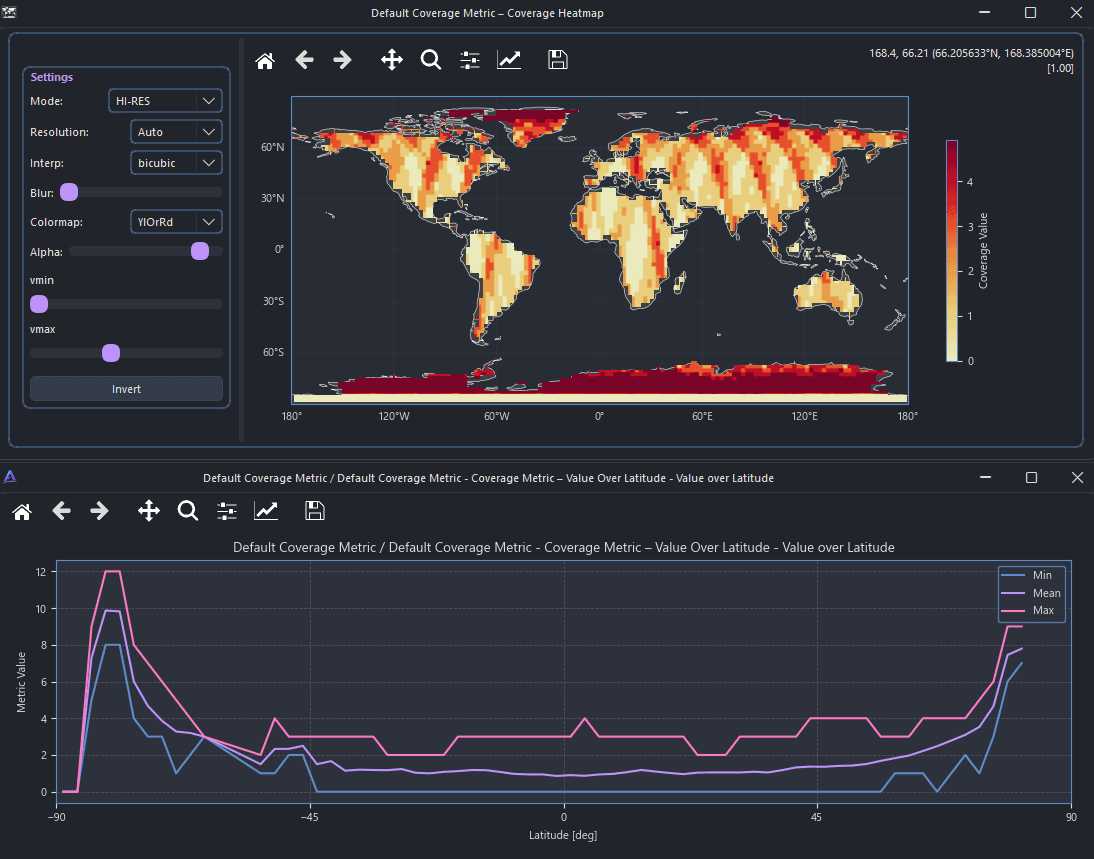
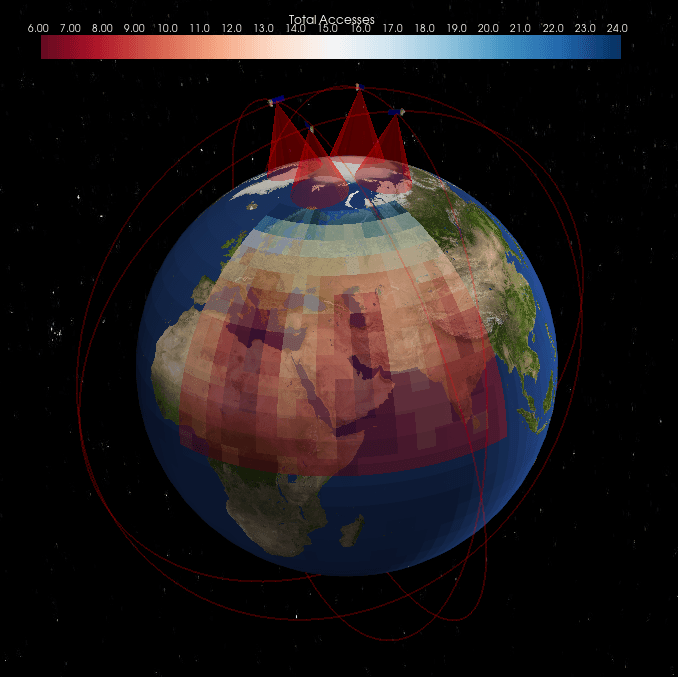
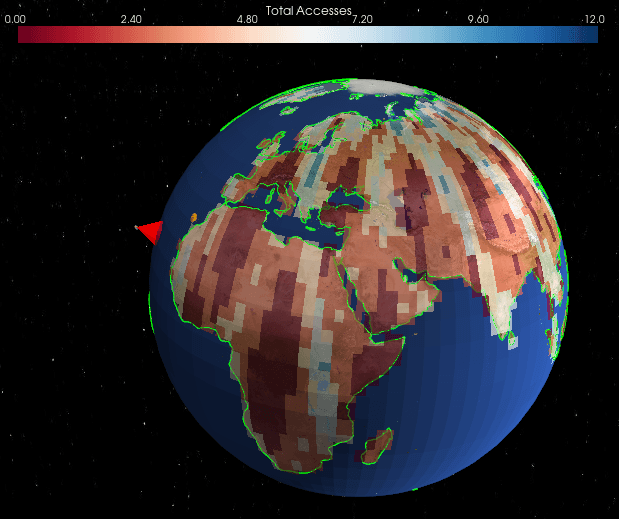
Visualisation plays a crucial role in this process. Heatmaps, cumulative coverage maps and latitude-longitude statistics reveal under-covered regions, highlight redundancy and show how coverage accumulates throughout the mission timeline.
By integrating geometry, sensor models, multi-asset aggregation and time-based metrics, coverage assessment becomes a powerful system-level analysis tool — transforming orbital motion into actionable mission performance.