Designing Satellite Orbits: A Practical Guide for Early Mission Analysis
How to Design a Satellite Orbit: From Mission Concept to LEO, SSO, GTO and GEO
Designing an orbit is one of the most critical decisions in any space mission. Long before hardware is defined, the orbit already determines coverage, revisit time, access to ground stations, eclipse seasons, illumination conditions and overall mission feasibility.
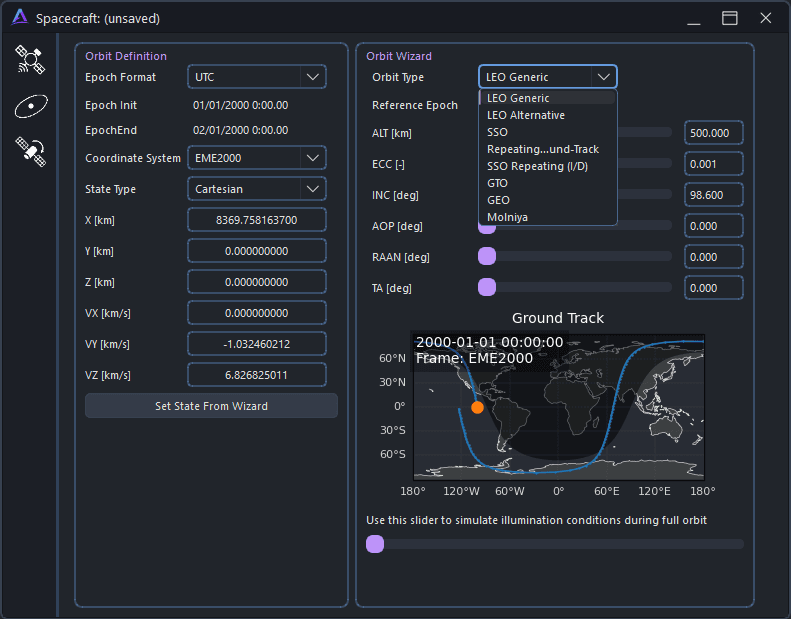
This is why ASTROLAB includes the Orbit Wizard within the Spacecraft Dialog: an interactive environment that allows engineers to design, simulate and visualise satellite orbits and immediately understand their impact at mission level.
Orbit design is not just about choosing numbers. It is about translating high-level mission objectives into physical behaviour around the Earth, understanding how geometry, lighting and coverage constraints shape the entire mission.
Orbit design starts with the mission, not with numbers
A common mistake in early mission analysis is starting directly from orbital parameters. Instead, orbit design should always begin by answering a fundamental question: What is the mission trying to achieve?
Earth-observation missions typically require high spatial resolution and frequent revisit times, naturally pointing towards Low Earth Orbit (LEO). Missions requiring stable and repeatable illumination benefit from Sun-Synchronous Orbits (SSO). Communications and persistent regional coverage usually drive the design towards Geostationary Orbit (GEO) or transfer orbits such as GTO. High-latitude monitoring and long dwell-time missions often rely on highly-elliptical Molniya-type orbits.
The Orbit Wizard is built around this logic. It allows engineers to start from the mission intent and progressively refine the orbit, visualising how each design choice affects coverage, illumination and access conditions.
Choosing a reliable starting orbit
Rather than designing an orbit from scratch, early mission analysis is far more effective when starting from a known orbital family and iterating.
Common starting points include circular LEO for baseline Earth-observation concepts, Sun-synchronous orbits for imaging missions with strict illumination constraints, Geostationary Transfer Orbit (GTO) as a stepping stone towards GEO, and highly-elliptical orbits for specialised regional coverage.
Starting from a recognised orbit type allows engineers to focus on mission behaviour instead of low-level orbital mechanics. Using the Orbit Wizard, these baseline configurations can be explored interactively, providing immediate insight into how the orbit evolves and how the spacecraft interacts with the Earth.
Adjust only the parameters that really matter
During early design, not every orbital parameter has the same impact. A small set of parameters drives most mission-level effects:
Altitude or semi-major axis controls footprint size, revisit time and atmospheric drag sensitivity.
Inclination defines which latitudes the satellite can reach and how ground coverage is distributed.
Eccentricity shapes how time is spent along the orbit and enables dwell-time optimisation.
RAAN and argument of perigee determine how the orbit is oriented relative to Earth and the Sun.
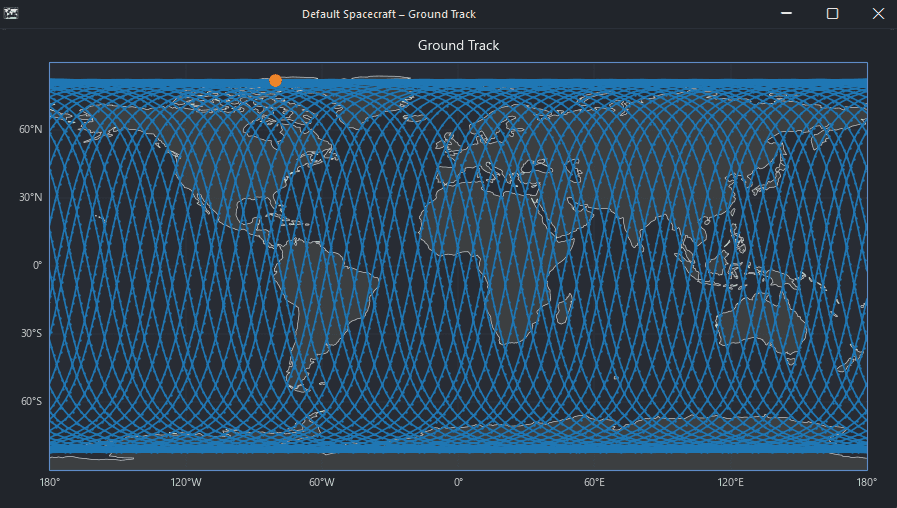
The goal at this stage is not precision, but understanding trends, constraints and trade-offs. Ground-track visualisation acts as a reality check: by analysing the ground track, engineers can confirm whether the orbit reaches the regions of interest, whether latitude coverage matches expectations, and how the orbit evolves and repeats over time.
Orbit design is only the first step. Coverage analysis, access windows, visibility constraints, power budgets and system-level performance all depend on the selected orbit. By integrating orbit design, simulation and visualisation, ASTROLAB enables fast and informed decisions early in the mission lifecycle — when changes are inexpensive and insight is most valuable.
This is exactly what the Orbit Wizard is built for.