Assesing Collision Risk in Orbit
Deterministic conjunction analysis: assessing collision risk in orbit
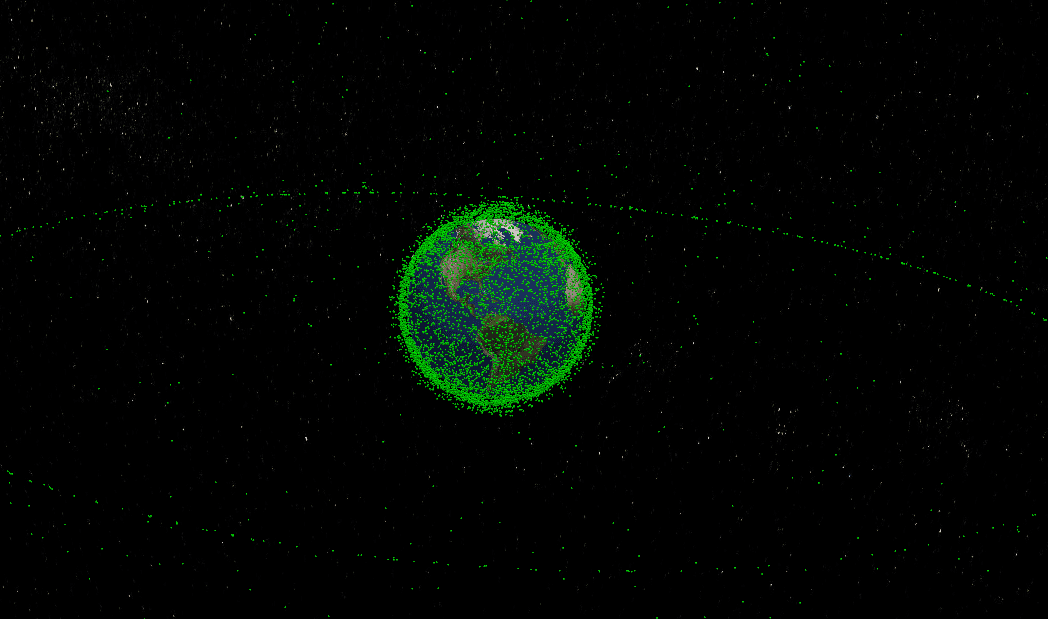
As the number of operational satellites and debris objects continues to increase, collision risk has become a central concern in mission operations.
Conjunction analysis evaluates whether two objects in orbit may come dangerously close to each other and estimates the likelihood and severity of potential collisions. Unlike high-level statistical approaches, deterministic conjunction analysis focuses on individual encounters, enabling detailed investigation of specific events.
By combining precise orbital propagation with uncertainty modelling, deterministic analysis transforms raw ephemerides into actionable collision risk assessments.
Introducing space object catalogues into mission analysis
Conjunction analysis begins by understanding the environment in which a spacecraft operates.
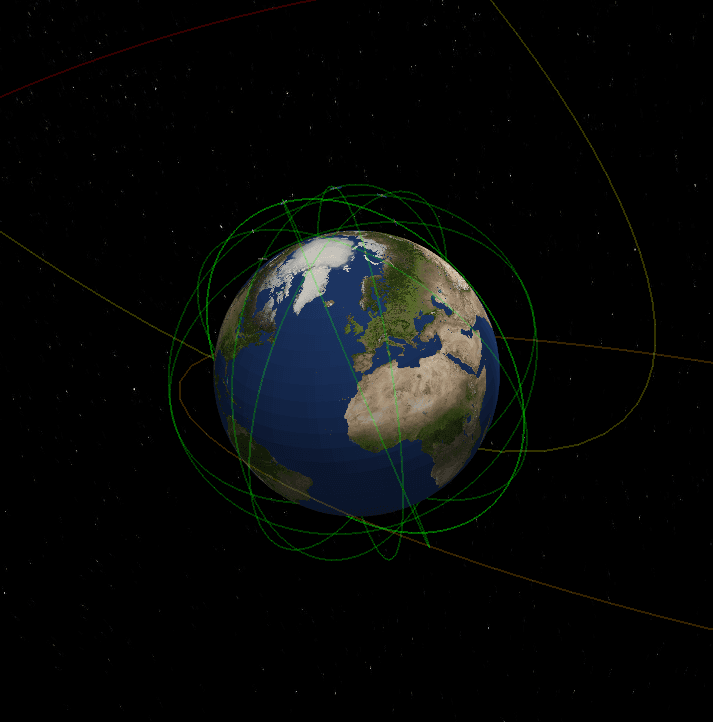
Orbital catalogues derived from publicly available TLE data provide a continuously evolving representation of the space object population, including operational satellites, defunct spacecraft and debris fragments.
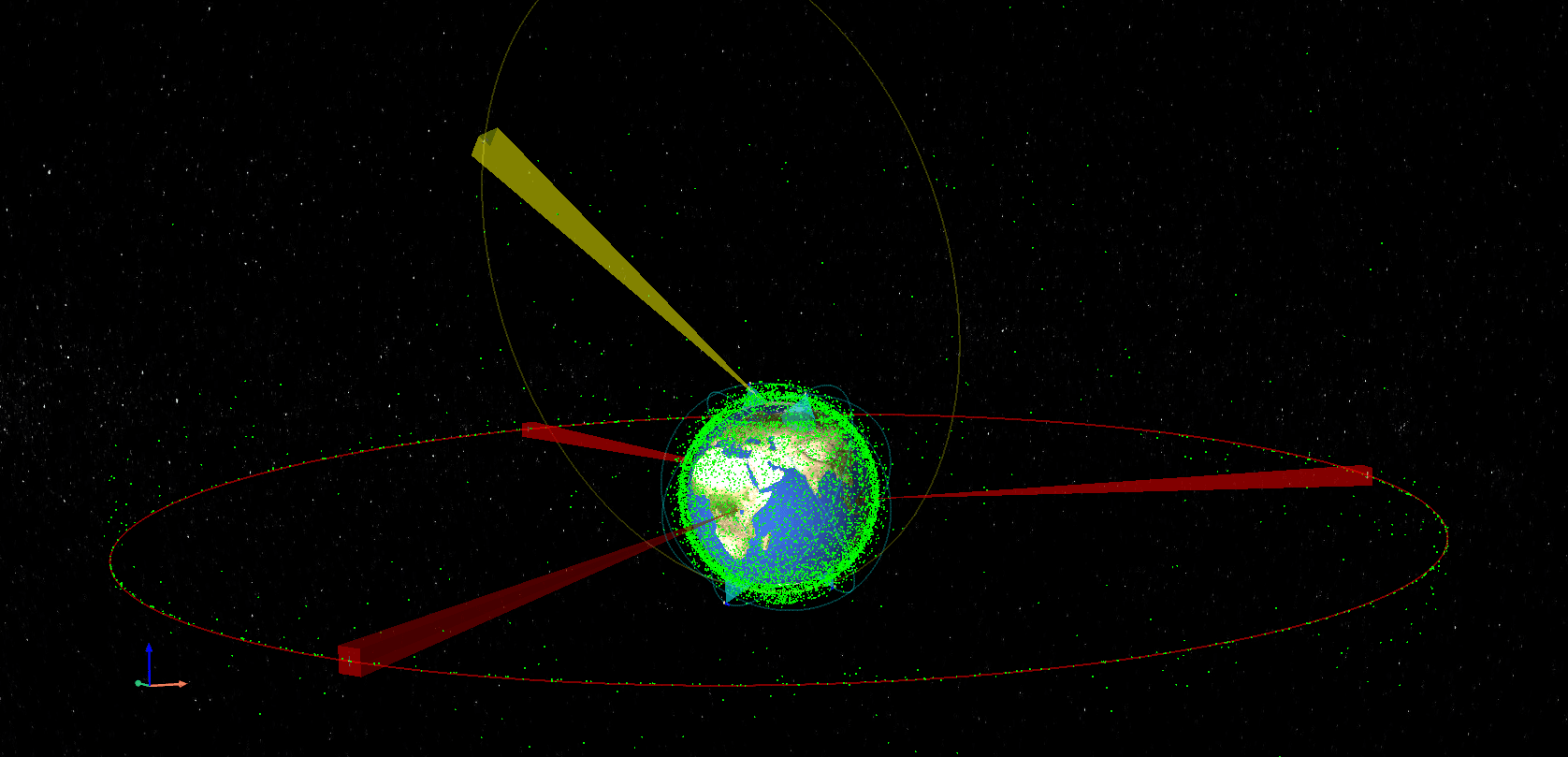
By introducing these catalogues as mission assets, engineers can treat external space objects in the same framework as their own spacecraft, enabling systematic identification of close approaches and interaction events within a unified mission model.
Selecting encounters and computing time of closest approach
Once catalogue objects are introduced into the mission scenario, deterministic conjunction analysis identifies potential encounters between a spacecraft and surrounding objects.
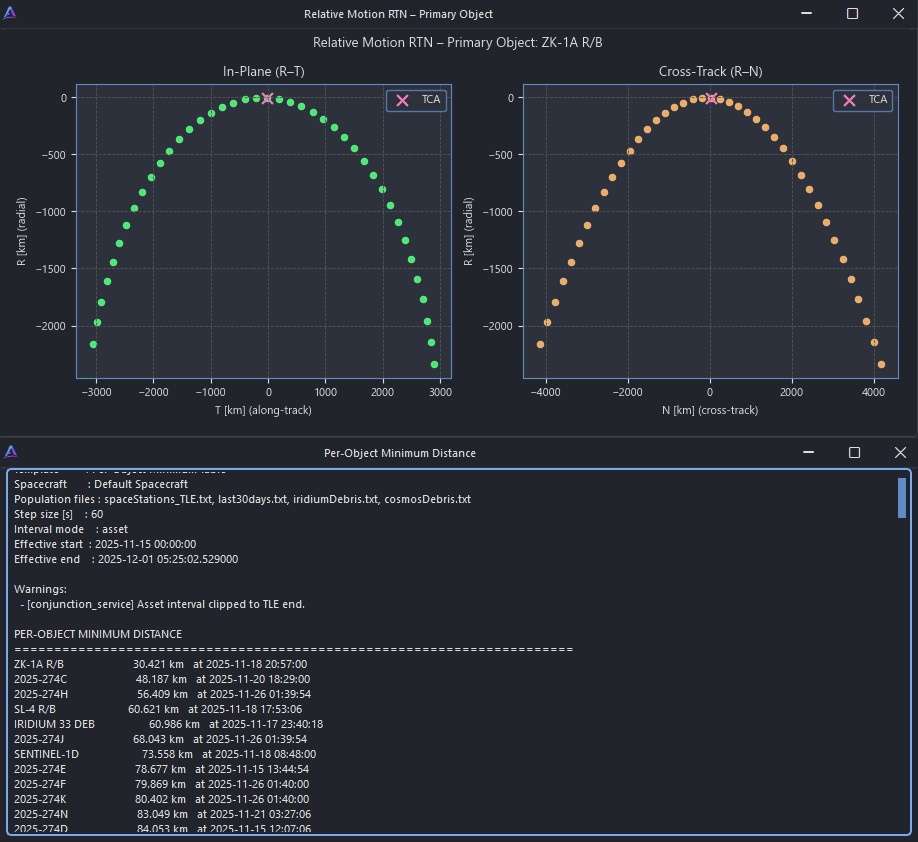
For each candidate event, the analysis determines the Time of Closest Approach (TCA) — the instant at which the relative distance between two objects is minimised. This provides the temporal anchor for all subsequent risk evaluation.
At TCA, relative position and velocity vectors are computed in an appropriate encounter frame, forming the geometric basis for assessing collision likelihood and miss distance.
Modelling uncertainty with fixed covariance assumptions
Precise orbit knowledge is never perfect. Even with high-quality ephemerides, uncertainty remains in both position and velocity.
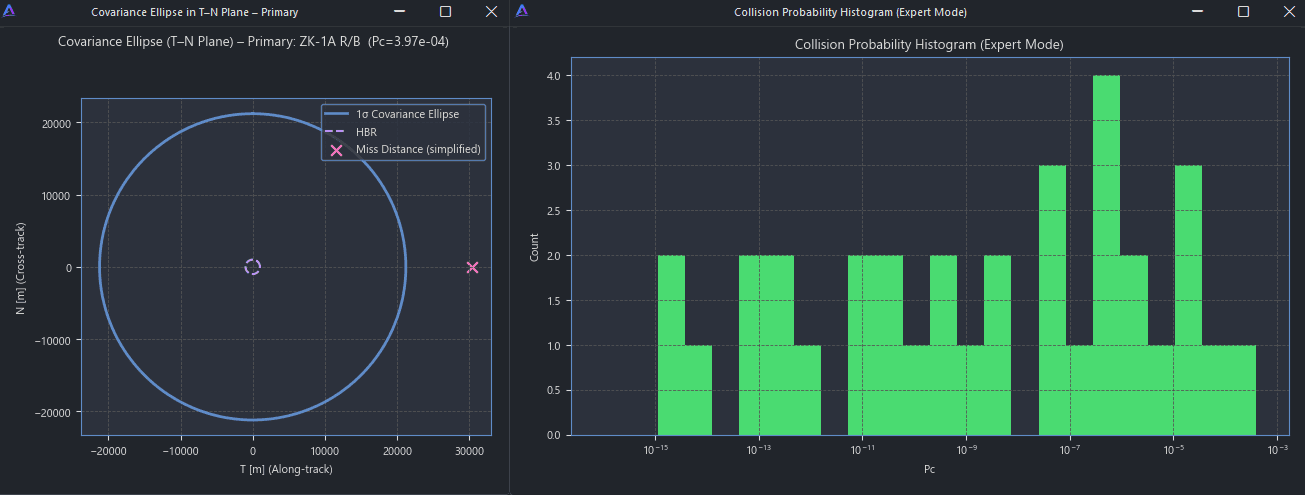
Deterministic conjunction analysis incorporates this uncertainty through covariance models, which can be defined using fixed assumptions for position and velocity dispersion. These covariance representations describe the expected uncertainty envelope of each object at the time of encounter.
By combining relative geometry with covariance information, engineers can estimate miss distances, confidence regions and potential collision risk — enabling informed decisions on whether mitigation manoeuvres are required.